
+86-15093398255
MULTIMEDIA FILTERS (WATER INDUSTRY)
Multi-Layer Water Purification Systems
The replacement cycle of filter media in multi-media filters is not fixed. It mainly depends on factors such as the type of filter media, influent water quality, operating conditions, and filtration effect. A comprehensive judgment based on the actual situation is necessary. The following are references and judgment criteria for the replacement cycles of common filter media:
I. Reference for Replacement Cycles of Different Filter Media
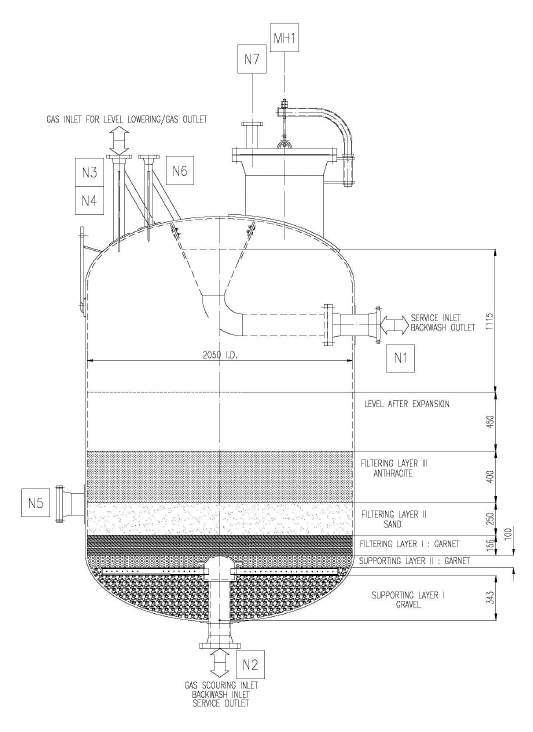
Multi-media filters typically use "layered filter media" (such as anthracite, quartz sand, garnet, etc., with density increasing from top to bottom). The replacement cycles of different filter media vary considerably:
* Anthracite filter media: Low density (1.4-1.6 g/cm³), mainly traps large particles of impurities, easily worn and lost, generally replaced every 1-2 years.
* Quartz sand filter media: Medium density (2.6-2.7 g/cm³), plays a major filtration role, has strong wear resistance, usually replaced every 2-3 years. Garnet/magnetite filter media: High density (4.0-5.0 g/cm³), suitable as a support layer or deep filtration layer; slow wear and tear, requiring replacement every 3-5 years.
Activated carbon filter media: If used for adsorbing organic matter and odors, it has a faster saturation rate and a shorter replacement cycle, generally 3-6 months (depending on adsorption capacity).
II. Criteria for Determining Early Replacement of Filter Media
The filter media should be replaced or replenished promptly, even if the reference cycle has not yet expired, under the following circumstances:
Significantly decreased filtration efficiency:**
Continuously increasing effluent turbidity (exceeding design standards, e.g., effluent exceeding standards when raw water turbidity ≤ 5 NTU);
A significant shortening of the filtration cycle (e.g., from 24 hours to within 8 hours).
Severe filter media wear or contamination:
A significant reduction in filter media layer height after backwashing (loss exceeding 10%);
Filter media caking, adhesion of oil or chemical contaminants, which cannot be restored by backwashing (e.g., long-term filtration of oily wastewater leading to filter media failure).
Abnormal inlet/outlet pressure difference:
The inlet/outlet pressure difference consistently exceeds 0.1 MPa during operation (design value is typically 0.05-0.1 MPa), and cannot be reduced after backwashing.
III. Measures to Extend Filter Media Lifespan
* Strengthen pretreatment (e.g., adding bar screens or sedimentation tanks) to reduce large particulate impurities entering the filter;
* Standardize backwashing operations (controlling backwashing intensity and time) to avoid excessive wear or loss of filter media;
* Regularly check the flatness of the filter media layer and replenish lost media promptly (at least 1-2 times per year).
Through proper maintenance and timely replacement, the multi-media filter can ensure long-term stable operation and is suitable for drinking water treatment, industrial circulating water, wastewater treatment, and other applications.


 to scroll
